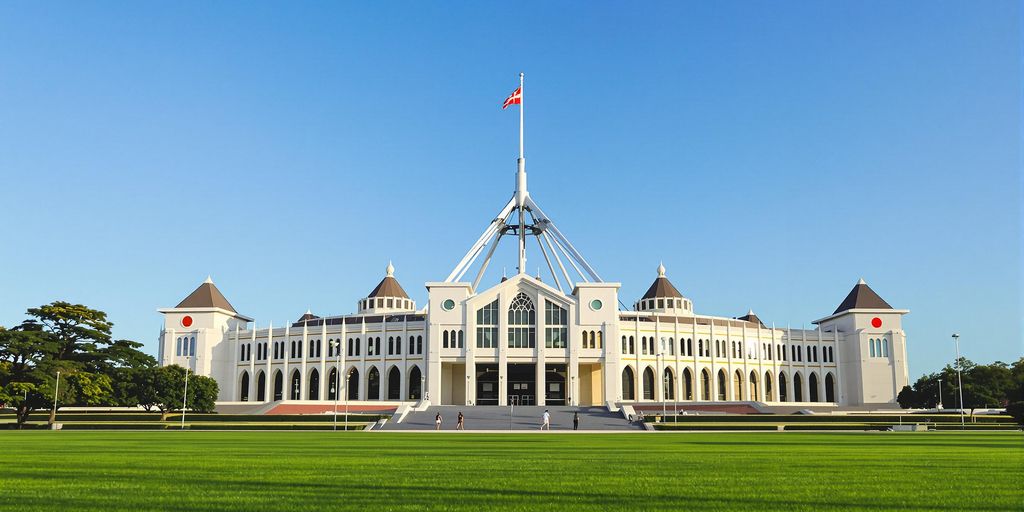
So, you want to know about how the Australian government works? It’s a bit like a big machine with different parts that all have to do their jobs. We’ve got a parliament, which is where laws get made, and an executive, which carries out those laws. It’s all set up by the Constitution, which is basically the rulebook for the country. Understanding this setup helps explain why things happen the way they do in Australia.
Key Takeaways
- The Australian Parliament, established in 1901, is bicameral, meaning it has two houses: the Senate and the House of Representatives, plus the King (represented by the Governor-General).
- Its main jobs include making and changing laws, representing Australians, forming the government, and keeping an eye on government actions.
- Australia follows a system of parliamentary government where the executive branch comes from the parliament, and responsible government, meaning the executive is accountable to the parliament.
- The legislative process involves introducing a bill, debating its principles, and going through stages for amendments and review before it can become law.
- The executive government, led by the Prime Minister and Cabinet, is responsible for implementing laws and managing the country, with ministers appointed from within parliament.
Understanding The Australian Congress
Australia’s federal government structure is built around a Navigating the Australian Congress, which means the executive branch actually comes from within the legislature. It’s a bit different from how some other countries do things, like the United States, where there’s a clearer separation. Here, the legislative and executive functions tend to overlap because the people running the government, the ministers, are also members of Parliament. This setup is a key part of what’s called responsible government, meaning the government has to answer to Parliament for its actions. It’s all rooted in the Australian Constitution, which established this framework back in 1901. The Parliament itself is made up of the King, represented by the Governor-General, and two houses: the Senate and the House of Representatives. It’s the main body for making federal laws, representing the Australian people, and keeping the government in check. It’s a system that has evolved over time, heavily influenced by the Westminster tradition.
The Bicameral Structure of Parliament
The Australian Parliament operates with two chambers, a setup known as bicameralism. This means there’s the Senate, often called the ‘upper house,’ and the House of Representatives, the ‘lower house.’ Each house has its own specific roles and responsibilities in the law-making process. For instance, bills usually start in the House of Representatives, but they have to pass through both houses to become law. It’s designed to provide a system of checks and balances, where one house can review and scrutinize the work of the other. This structure helps ensure that legislation is thoroughly debated and considered before it’s enacted.
The Role of the Governor-General
The Governor-General is the representative of the King in Australia. While the King is the head of state, the Governor-General carries out most of the constitutional duties on a day-to-day basis. This includes things like assenting to bills passed by Parliament, which is the final step in making a bill a law. They also formally appoint the Prime Minister and ministers, and can summon or dissolve Parliament. It’s important to remember that the Governor-General acts on the advice of the government, so their role is largely ceremonial and constitutional, rather than political.
The King’s Constitutional Function
In Australia’s constitutional monarchy, the King is the head of state. However, the King’s role is almost entirely symbolic and constitutional. The actual powers and functions associated with the monarchy are exercised by the Governor-General, who acts as the King’s representative in Australia. The King’s involvement in the day-to-day running of the government is minimal, and their constitutional function is primarily to provide a symbol of national unity and continuity. The existence of the King as head of state is a matter of constitutional law, but their practical influence on government operations is very limited.
Core Functions of the Australian Parliament
The Australian Parliament, established in 1901, is the legislative body of the Commonwealth. It’s a busy place with several key jobs to do. Think of it as the engine room for making and checking laws, and also where the country’s leaders are chosen.
Law Making and Amendment
This is probably the most well-known function. Parliament debates and votes on proposed laws, called bills. If a bill gets approved by both the House of Representatives and the Senate, and then receives assent from the Governor-General, it becomes an Act of Parliament – a law. This process can be quite involved, with bills often going back and forth between the Houses for changes. It’s how the government develops national policies in areas like trade and the environment.
Representing the Australian People
Members of Parliament are elected by the people in their local areas (for the House of Representatives) or by the states and territories (for the Senate). Their job is to voice the concerns and interests of their constituents in Parliament. This means they need to be aware of what’s happening in their electorates and bring those issues to the national discussion. It’s a big responsibility, making sure everyone’s voice has a chance to be heard.
Scrutinizing Government Actions
Parliament doesn’t just make laws; it also keeps a close eye on what the government is doing. This is super important for accountability. Through questions in Parliament, committee inquiries, and debates, members can question ministers and government departments about their decisions and spending. This helps to make sure the government is acting properly and using public money wisely.
This oversight role is a key part of making sure the government stays answerable to the people, even though the executive government comes from within the parliament itself.
Forming Government and Opposition
After an election, the political party or coalition that can command the support of a majority in the House of Representatives forms the government. The leader of that party usually becomes the Prime Minister. The party or coalition with the next largest number of seats forms the official Opposition. The opposition plays a vital role by challenging government policies and offering alternative ideas. It’s a bit like a constant debate to find the best way forward for the country. You can find out more about the relationship between Parliament and the Executive Government on the Parliament of Australia website.
The Separation of Powers in Australia
Australia’s system of government is built on a core idea called the separation of powers. Think of it like dividing up jobs so no single person or group gets too much control. This setup is designed to keep things fair and prevent any one branch of government from becoming too powerful. It’s a pretty standard feature in many democracies, and Australia’s version is no different.
Legislative Power
This is the power to make laws. In Australia, this job falls to the Parliament. The Parliament is made up of the King (represented by the Governor-General), the House of Representatives, and the Senate. For a proposed law, or bill, to become actual law, it needs to get the green light from both the House and the Senate. After that, the Governor-General gives it the final sign-off. Besides making laws, Parliament also has to approve government spending and taxation, and it’s a place where big public issues get talked about.
Executive Power
This is the power to carry out and enforce the laws that Parliament makes. The Executive Government is headed by the Prime Minister and includes the Cabinet and Ministers. They are the ones who run the day-to-day business of the country, manage government departments, and implement policies. It’s important to remember that in Australia, the Executive Government is drawn from within the Parliament itself, which is a key feature of our parliamentary system. This overlap means the Executive is directly accountable to the Parliament.
Judicial Power and the High Court
This is the power to interpret laws and decide how they apply in specific cases. This role belongs to the courts, with the High Court of Australia at the top. The High Court has a really important job: it can look at laws made by Parliament and decide if they go against the Constitution. If a law is found to be unconstitutional, it’s thrown out. The independence of the judiciary is a big deal here; it means judges can make decisions based on the law without pressure from the Parliament or the Executive. This independence is vital for keeping the separation of powers working properly and for the overall health of our political system. You can find more details about the High Court’s role in interpreting the Constitution on the Parliament of Australia website.
The idea is that by splitting governmental authority into these three distinct branches – making laws, enforcing laws, and interpreting laws – each branch can keep an eye on the others. This system of checks and balances is what helps protect against abuses of power and keeps the government accountable to the people it serves.
Parliamentary Government and Responsible Government
Australia’s system of government is a bit of a hybrid, really. We call it a parliamentary government, and that means the people running the country, the executive, actually come from within the parliament itself. Think of it like this: the folks who make the laws are also the ones who carry them out. This leads to a bit of an overlap between the legislative and executive branches, which is different from how some other countries do things.
Overlap of Legislative and Executive Functions
So, the Prime Minister and the ministers, who are part of the executive government, are almost always members of either the House of Representatives or the Senate. They’re elected to parliament first, and then they get appointed to their ministerial roles. This close connection means that the government usually has the numbers in the House of Representatives to get its laws passed. It’s not a perfect separation, but it’s how the system is designed to work.
Executive Accountability to Parliament
But here’s the key part of ‘responsible government’: the executive has to answer to the parliament. The government can’t just do whatever it wants without being questioned. The opposition party, which is the next biggest group in parliament, has a formal role in challenging the government’s decisions and actions. Ministers have to show up in parliament to answer questions, explain their policies, and defend their records. If the government loses the confidence of the House of Representatives, it’s supposed to resign. This accountability is a big deal for keeping the government in check.
The Westminster System Influence
This whole setup is heavily influenced by the Westminster system, which originated in the United Kingdom. It’s a tradition that emphasizes the link between the legislature and the executive, and the executive’s responsibility to the elected representatives. Unlike a presidential system, where the president is elected separately from the legislature, in Australia, the executive’s power flows directly from its ability to command a majority in the parliament. This means that political parties play a huge role, and party discipline is generally quite strong. It’s a system that’s been around for a long time, and it shapes how our government operates day-to-day.
The Legislative Process in Australian Congress
So, how does a bill actually become a law in Australia? It’s a pretty involved process, not just a quick vote. Think of it like a journey with several stops. First off, someone has to actually propose a bill. This can be a government minister or even a regular member of parliament, but they have to give notice first. It’s like saying, “Hey, I’ve got an idea for a new law, and here’s what it’s about.” This notice gets published so everyone knows what’s coming.
Introducing a Bill
After that notice period, the bill is formally introduced. The person bringing it in reads out its full title. In the House of Representatives, this is followed by a speech explaining the bill’s main points – the second reading speech. Over in the Senate, the Clerk just reads the short title, and then the introducer gives their second reading speech. After this initial introduction and speech, there’s usually a break of a few days before any real discussion happens. This gives everyone time to read the bill and think about it. It’s a bit like letting a new recipe sit for a day before you decide if you’re going to cook it.
The Second Reading Debate
This is where the real discussion happens. Members of Parliament get up and talk about the bill, sharing their thoughts on its core ideas. They might agree, disagree, or suggest changes. At the end of this debate, a vote is taken. If the majority says “no” to the bill at this stage, it’s dead. If they say “yes,” it moves on. If no one has any amendments in mind, it can go straight to the final stage. But usually, there are some proposed changes, and that leads us to the next step.
Amendments and Committee Stages
When amendments are proposed, the bill usually goes into a committee stage. This is where the bill is examined in detail, clause by clause. It’s a chance to really pick apart the specifics and make sure everything is clear and fair. Think of it like a detailed review. Sometimes, bills are related and are presented together as a package, which can make the process a bit more complex. Money bills, which deal with taxes or government spending, have a special path, only starting in the Assembly but still needing to pass both Houses. The whole process is designed to allow for thorough consideration, and you can find more details on the procedures for voting in the Senate at [0fec].
The legislative process is designed to be thorough, allowing for debate and amendment at multiple stages. This ensures that laws are carefully considered before they are enacted, reflecting the diverse views of the Australian people and the complexities of governance.
The Executive Government’s Role
The executive government in Australia is where the rubber meets the road, so to speak. It’s the part of the system that actually puts the laws passed by Parliament into action. Think of it as the engine that drives the country forward based on the blueprints created by the legislature. The Prime Minister and their Cabinet are at the heart of this operation. They’re the ones making the big decisions about how the country is run day-to-day.
The Prime Minister and Cabinet
The Prime Minister is the leader of the political party or coalition that commands a majority in the House of Representatives. They’re not directly elected to the role by the people, but rather by their fellow members of Parliament. The Cabinet is a group of senior ministers, chosen by the Prime Minister, who head up different government departments. This group is the main policy-making body, deciding on major government initiatives and legislative proposals. It’s where the heavy lifting of governance happens, though the Prime Minister and Cabinet aren’t actually mentioned in the Constitution itself; their existence is more of a convention, a tradition that’s just always been the way things are done.
Ministerial Appointments
Ministers are appointed by the Governor-General, but this is done on the advice of the Prime Minister. These ministers are typically members of Parliament, drawn from both the House of Representatives and the Senate, though most come from the lower house. Each minister is responsible for a specific government department, like Health, Defence, or Treasury. They manage the day-to-day operations of their department and are accountable for its performance. The current system allows for a significant number of ministers and parliamentary secretaries, who assist ministers in their duties. It’s a big team effort to keep everything running smoothly.
The Federal Executive Council
This might sound a bit formal, and it is. The Federal Executive Council is the constitutional body that formally advises the Governor-General. It’s not really a place for debating policy; it’s more about the official process of giving advice. All ministers and parliamentary secretaries are members, and they get the title ‘Honourable’. However, the entire council never actually meets. Instead, a small group of ministers, usually just two plus the presiding officer, attend meetings. They formally approve things like making regulations, ratifying treaties, or appointing people to positions. While it might seem like a formality, the process ensures that all executive actions are properly documented and legally sound. It’s a way to keep the executive government accountable for its actions, even if the meetings themselves are quite brief. You can find more details about how the government operates on the official Parliament of Australia website.
The executive government’s power is derived from multiple sources: constitutional authority vested in the Governor-General, political support from the electorate through parliamentary elections, and established conventions. This blend of formal power and traditional practice shapes how Australia is governed.
Wrapping It Up
So, that’s a look at how the Australian Parliament works. It’s a pretty involved system, with the King represented by the Governor-General, and then the two Houses – the Senate and the House of Reps – doing the heavy lifting. They’re in charge of making laws, representing us, and keeping the government in check. It’s all part of a parliamentary system where the government comes from within Parliament itself, and importantly, has to answer to it. It might seem complicated, and honestly, the laws themselves can be a real maze sometimes, but understanding these basics helps a lot. It’s how our country makes decisions and keeps things running.
Frequently Asked Questions
What are the main parts of the Australian government?
Australia’s government has two main parts: the Parliament, which makes the laws, and the Executive, which carries out the laws. The King, represented by the Governor-General, is the head of state, but the Prime Minister and their ministers, who are part of the Parliament, run the country day-to-day.
Why does Australia have two houses of Parliament?
The Parliament has two houses: the Senate and the House of Representatives. Both houses have to agree on a bill before it can become a law. This two-house system helps make sure laws are carefully considered.
What are the main jobs of the Australian Parliament?
The Parliament’s main jobs are to create and change laws, represent the people of Australia by discussing issues that matter to them, check that the government is doing its job properly, and provide a place for the government and the official opposition to be formed.
What does ‘parliamentary government’ and ‘responsible government’ mean in Australia?
Australia’s system is called a parliamentary government because the people who run the country (the Executive) are also members of the Parliament. It’s also ‘responsible government’ because the Executive must answer to the Parliament for their actions.
How does a bill become a law in Australia?
A bill, which is a proposed law, is introduced in one of the houses. It’s then debated, possibly changed, and voted on. If it passes both houses, it becomes a law. This process ensures that laws are thoroughly reviewed before they are enacted.
What role does the High Court play in Australia’s government?
The High Court of Australia can review laws made by Parliament to make sure they follow the Constitution. If a law goes against the Constitution, the High Court can say it’s invalid, which means it won’t be used.